
"It is quite possible that the rates will remain low in the near to medium term, but that will depend on how conditions evolve," said RBI Governor Sanjay Malhotra.

Reserve Bank Governor Sanjay Malhotra on Friday said the key policy rates will remain at low levels for a long period and may go down even further.

In spite of Governor Raghuram Rajan's repeated concerns about inflation, many think there may still be a loosening of stance.
The change in stance to neutral from accommodative in the June monetary policy meeting does not necessarily signal that the Reserve Bank of India's (RBI's) rate setting body - monetary policy committee (MPC) - will go on a prolonged pause on rate cuts going forward, believe experts.

Markets will look for clear guidance on how the MPC interprets the uncertainty and what it implies for the future course of monetary policy, points out Rajeswari Sengupta.

Fitch Ratings on Friday said persistently higher oil prices could cause India's retail inflation to rise faster than the expected gradual pace, and lead to a slowdown in economic growth in the first half of financial year 2026-27 (FY27).

Cleaner balance sheets, regulatory support and strong growth prospects helped Indian private banks attract over $6 billion in foreign capital, with more deals expected in 2026.

Among the 30 Sensex firms, Asian Paints, Infosys, JSW Steel, UltraTech Cement, Power Grid, Larsen & Toubro, HCL Technologies and Tata Steel were the biggest laggards. Tata Motors, HDFC Bank, Bharti Airtel, ITC, IndusInd Bank and Axis Bank were the gainers.

After effecting two back-to-back 25 basis points rate cuts, Reserve Bank Governor Sanjay Malhotra on Wednesday hinted at another reduction in key policy rate by changing the central bank's monetary stance to 'accomodative' from 'neutral', which may further lower EMIs for consumers.

From the Sensex firms, Tata Motors jumped the most by 5.54 per cent, followed by Kotak Mahindra Bank, Trent, Sun Pharma, Axis Bank, and ICICI Bank. However, Bajaj Finance, State Bank of India, UltraTech Cement and Tata Steel were among the laggards.

While the economy will wait for a rate cut in December, the banking industry should be happy with the wave of liberalisation -- a big push for growth in bank credit, points out Tamal Bandyopadhyay.

With concern on food inflation ebbing with the monsoon progressing well, the Reserve Bank of India (RBI) is warming up to the idea of a change in stance to "neutral" from "withdrawal of accommodation", according to economists. In his speech on Thursday during the annual event of the Federation of Indian Chambers of Commerce and Industry-Indian Banks' Association, RBI Governor Shaktikanta Das said: "The balance between inflation and growth is well-poised."

RBI Governor Duvvuri Subbarao on Tuesday defended the bank's decision to keep the key policy rate unchanged saying inflation could rise to above 8 per cent in the near-term.

'Rate cut looks unlikely and there is reason to believe that the cycle is over.'

Retail inflation dipped to an over six-year low of 2.82 per cent in May due to subdued food prices, remaining below the RBI's median target of 4 per cent for the fourth consecutive month, according to government data released on Thursday. Consumer Price Index (CPI)-based retail inflation was 3.16 per cent in April and 4.8 per cent in May 2024.
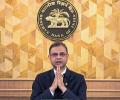
Shrugging off concerns over the depreciation of rupee, the RBI has cut interest rate by 25 basis points to 5.25 per cent in a bid to further bolster economic growth, which rose to a six-quarter high of 8.2 per cent in the second quarter of the current financial year.
The Reserve Bank of India (RBI) on Wednesday kept its policy interest rate unchanged at 5.5 per cent for the second consecutive time, citing concerns over tariff uncertainties.

'We never waste a crisis. There will be learning and the supervisory tools will get better with each episode.'

Sanjay Malhotra has made structural changes to banking regulation to bring down costs and increase efficiency. Plus, he kicked off a benign interest regime. But there are challenges ahead.
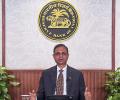
For the time being, the RBI is done with the cuts. A cut in October, which many are still predicting, is not certain. Of course, if growth nosedives, the script will be different, expects Tamal Bandyopadhyay.

State Bank of India, Tech Mahindra, Larsen & Toubro, Tata Steel, Sun Pharma, Infosys, HCL Tech, Axis Bank, Tata Consultancy Services and NTPC were among the biggest laggards among Sensex shares. Nestle, Hindustan Unilever, Titan, Power Grid, UltraTech Cement and ITC were among the gainers.

Equity markets fell on Monday, with benchmark indices recording their worst session in over two months amid caution ahead of the US Federal Reserve's (Fed's) policy announcement and renewed uncertainty over the US-India trade deal. Sustained selling by foreign portfolio investors (FPIs) also weighed on sentiment.

From the Sensex firms, State Bank of India, Bajaj Finserv, Bajaj Finance, Maruti, HCL Tech, Larsen & Toubro, Mahindra & Mahindra and Infosys were among the major winners. However, Hindustan Unilever, Eternal, Tata Motors Passenger Vehicles, and Sun Pharma were among the laggards.

A Kotak research report expects RBI to cuts rates by 50 basis points in the first half of 2019. RBI will announce its sixth bi-monthly monetary policy on February 7.

The RBI is fully aware that the high-cost loans and high indebtedness of the borrowers could pose financial stability risks, if not addressed by these NBFCs. Governor Shaktikanta Das has issued a stern warning, saying the RBI is closely monitoring these areas and will not hesitate to take appropriate action, if necessary, if the culprits don't opt for self-correction. Watch out for some action, soon, notes Tamal Bandyopadhyay.

Benchmark interest rate hiked by 50 basis points to 3-year high at 5.90 per cent. Economic growth projection for FY23 cut to 7% from 7.2% estimated in August. GDP expected to grow at 6.3% in September quarter, 4.6% each in December and March quarters.
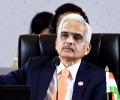
Reserve Bank Governor Shaktikanta Das on Friday said that this stage would have been "premature" and "very very risky" as the retail inflation is still high, and future monetary policy action would depend upon the income data and outlook. Earlier this month, the RBI continued to maintain the status quo in the short-term lending interest rate (repo), citing inflationary concerns, though it changed the monetary policy stance to neutral.

The transmission of the February and April rate cuts is now complete, validating the central bank's monetary stance and contributing to a revival in credit growth, said Reserve Bank of India (RBI) Governor Sanjay Malhotra on Friday. "We now have preliminary figures for June credit rates, and we find that for new loans, the rates are lower by at least 50 basis points (bps)... within two months of our 50-bp cut, we are in June, and the whole of the monetary policy transmission has happened.
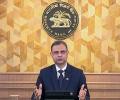
Reserve Bank will "wait and watch" the evolving situation before deciding on any further rate cut, Governor Sanjay Malhotra has said as he emphasised that both growth and price stability are equally important. With inflation on a downward trend, the RBI's Monetary Policy Committee (MPC) has been reducing the benchmark repo rate and has adopted a neutral stance, which also gives the flexibility to either cut or hike the rate going forward. The central bank has cummulatively reduced the repo rate by 100 basis points since February.
Since February 2025, the RBI has reduced the policy rate by 100 basis points. In its previous policy review in April, it had also trimmed the repo rate by 25 basis points to 6 per cent.
During the fourth quarter of last fiscal, the economy had grown at a nine-year low rate of 5.3 per cent. During the entire fiscal of 2011-12, the economy grew by 6.5 per cent.
RBI is likely to continue with its tough stance on monetary policy to maintain price and financial stability.

Ahead of the monetary policy review, RBI governor D Subbarao is expected to meet Prime Minister Manmohan Singh and finance minister Pranab Mukherjee on October 23.

'Other sectors that manage the savings pools of Indians are giving tough competition to life insurance companies.'
RBI's announcement that it would tighten liquidity and re-emphasize its anti-inflationary monetary policy stance could come at the cost of slower short-term economic growth, according to Moody's.

The rupee continued to face pressure in the first half of the current financial year (FY26), hitting fresh lows against the dollar, due to strengthening of the greenback, rising crude oil prices, and foreign outflows. Rupee has depreciated by 3.7 per cent so far in the current financial year after starting at a good note in April.
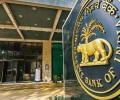
The Reserve Bank of India's rate-setting panel on Wednesday started discussions to firm up the next bi-monthly monetary policy amid expectations that it might retain status quo on interest rate but change its monetary policy stance amid rising inflation on account of geopolitical developments.
'The US reciprocal tariff has added another element of uncertainty and the central bank may prefer to wait and get further clarity.'

'In the long run, India's strong growth story and reforms to make assets globally attractive will determine the rupee's resilience.'
The RBI on Wednesday slashed key interest rate by 25 basis points, for the second time in a row, to support a shuttering economy hit by reciprocal tariffs imposed by the US. Following the rate cut, the key policy rate eased to 6 per cent providing relief to home, auto and corporate loan borrowers.
